News · Milestones
A new A&A study on the Milky Way's accretion history
Istiak Hossain Akib, a Graduate Member of CASSA, is the first and corresponding author of a new Astronomy & Astrophysics paper showing how the kinematics of globular clusters trace the Milky Way's ancient merger epochs.
We are delighted to share that Istiak Hossain Akib, a Graduate Member of CASSA, is the first and corresponding author of a new peer-reviewed study published in Astronomy & Astrophysics (A&A), one of the world’s leading journals in the field. The paper, “The accretion history of the Milky Way – V. The kinematics of most globular clusters trace the merger epochs,” appeared in A&A, Volume 710, A349 (2026) and was published on 26 June 2026.
Istiak is currently a PhD candidate at the Laboratoire d’Instrumentation et de Recherche en Astrophysique (LIRA), Observatoire de Paris, PSL University, France, and he carries his affiliation with the Center for Astronomy, Space Science and Astrophysics (CASSA) at Independent University, Bangladesh, into this work. He led the study alongside co-authors François Hammer and Yanbin Yang, both also at the Observatoire de Paris.
What the paper is about
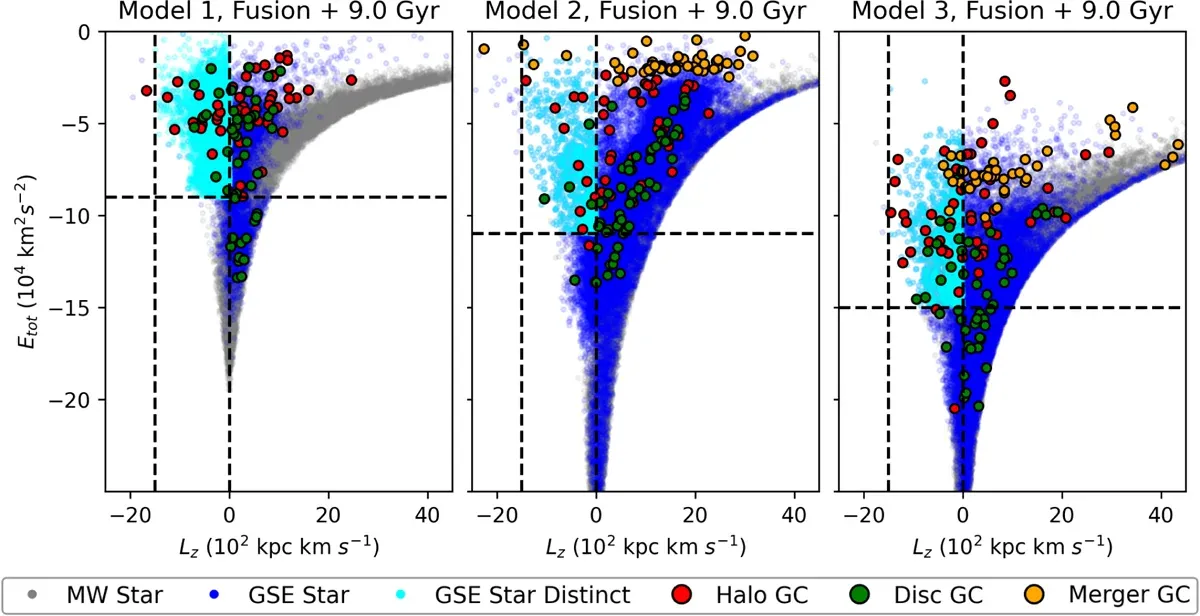
Our Milky Way grew, in part, by swallowing smaller galaxies. The debris of those ancient collisions still orbits the Galaxy today, and astronomers try to reconstruct this history by studying where stars and star clusters sit in the energy–angular momentum (E–Lz) plane. Many globular clusters (GCs) — dense, ancient swarms of stars — have been linked to past accretion events on the basis of their position in this plane, an association further supported by similarities in their age–metallicity relations. However, some studies have raised concerns about the reliability of globular clusters as tracers, as they may lose energy during mergers and gradually over time.
This study, the fifth in the group’s ongoing series on the accretion history of the Milky Way, puts that picture to the test using three N-body simulations of the Milky Way’s merger with Gaia-Sausage-Enceladus (GSE) — the most significant known merger in the Galaxy’s history — across a range of mass ratios and initial conditions.
Key findings
- Most globular clusters linked to GSE can indeed be associated with Milky Way accretion events in the E–Lz plane, supporting the observational approach the community has relied on.
- Globular clusters that originated in the disc of the GSE progenitor lose substantial orbital energy as they repeatedly plunge through dense disc material — and many would likely be destroyed by tidal shocks rather than survive.
- By contrast, halo-origin and merger-formed clusters retain orbital energies comparable to the GSE debris, which is why they remain reliable kinematic tracers of the merger epoch.
Together, the results strengthen the case for using globular-cluster kinematics, combined with age–metallicity information, to read the Milky Way’s accretion history — and they sharpen our understanding of which clusters make trustworthy fossils of that history.
Congratulations, Istiak
A first-author paper in a journal of A&A’s standing is a significant achievement, and we are proud to see a CASSA Graduate Member contributing at the frontier of Galactic archaeology. Many congratulations to Istiak Hossain Akib and his collaborators.
The paper is available via its DOI: 10.1051/0004-6361/202659473.