The Fog Lifts
At the end of the last lesson the Universe was a few minutes old and full of fresh hydrogen and helium nuclei (§1.3) — but it was not yet anything you could see through. It was a plasma: a hot soup of bare nuclei and free electrons (the tiny negatively charged particles of §1.2). Free electrons are superb at batting light around, so every photon (a particle of light) ricocheted endlessly off them and could never travel in a straight line. The Universe glowed, but it was opaque — a glowing fog, like the inside of the Sun.
Then, about 380,000 years after the Big Bang, the expanding Universe cooled to roughly 3,000 degrees (3,000 K — about half the temperature of the Sun's surface). That was finally cool enough for the electrons to be captured by the nuclei and settle into complete, neutral atoms. With the free electrons gone, there was nothing left to scatter the light: the fog lifted, and for the first time photons streamed freely across space. Physicists call this moment recombination, and the instant the light broke free the surface of last scattering. Drag the slider below to cool the young Universe through that threshold and watch the fog clear.
That liberated light has been travelling ever since — for 13.8 billion years — and it is still arriving today. But it no longer arrives as the hot glow it set out as. Across those eons space itself has expanded, and as it stretched it stretched the light's waves along with it. Space has grown about 1,100 times larger since, so each wave is now about 1,100 times longer than when it left. Stretching a light wave lowers its energy and reddens it; stretch it this far and it slides out of visible light, through the infrared, and into microwaves — a low-energy form of light, a close cousin of the visible light and radio waves of §0.4. Cooled by the same factor, the glow's temperature has dropped from 3,000 K to just 2.725 K — under three degrees above absolute zero, the coldest anything can ever be. This faint, sky-filling glow is the Cosmic Microwave Background (CMB) — the relic light promised at the close of §1.3. Slide the figure below to expand space and watch the glow stretch and cool.
The Baby Picture
Nobody set out to find the CMB — it was stumbled upon. In 1964, at Bell Labs in New Jersey, two radio engineers — Arno Penzias and Robert Wilson — were calibrating a giant horn-shaped antenna when they ran into a faint, steady hiss that came from every direction of the sky and never went away. They ruled out everything they could think of: city radio, the wiring, even the pigeons nesting inside the antenna (and the droppings they left). The hiss remained. A team at Princeton led by Robert Dicke had the explanation: this was the leftover heat of the Big Bang they had themselves been preparing to hunt for. The accidental hiss matched the predicted blackbody glow — the particular spread of colours any warm object gives off, set only by its temperature — of a once-hot Universe now cooled to a few degrees, something the rival "Steady State" theory could not explain. Penzias and Wilson shared the 1978 Nobel Prize for hearing the oldest light in the cosmos.
Hearing it was one thing; mapping it took satellites lofted above the blurring atmosphere. NASA's COBE (launched 1989) confirmed the CMB is the most perfect blackbody glow ever measured and, in 1992, caught the first hint of faint ripples in it. WMAP (2001) sharpened the picture many times over, and the European Space Agency's Planck satellite (launched 2009) delivered the exquisite all-sky map below. Planck worked from a quiet gravitational parking spot 1.5 million kilometres from Earth and observed at many wavelengths at once, so astronomers could subtract the Milky Way's own bright microwave glow — a band across the middle of the raw data — and reveal the primordial sky behind it. Hover anywhere on the map to magnify the faint ripples — the colour bar reads from blue (cooler, denser) to red (hotter, thinner) — and use the arrow keys to pan the magnifier across the sky.
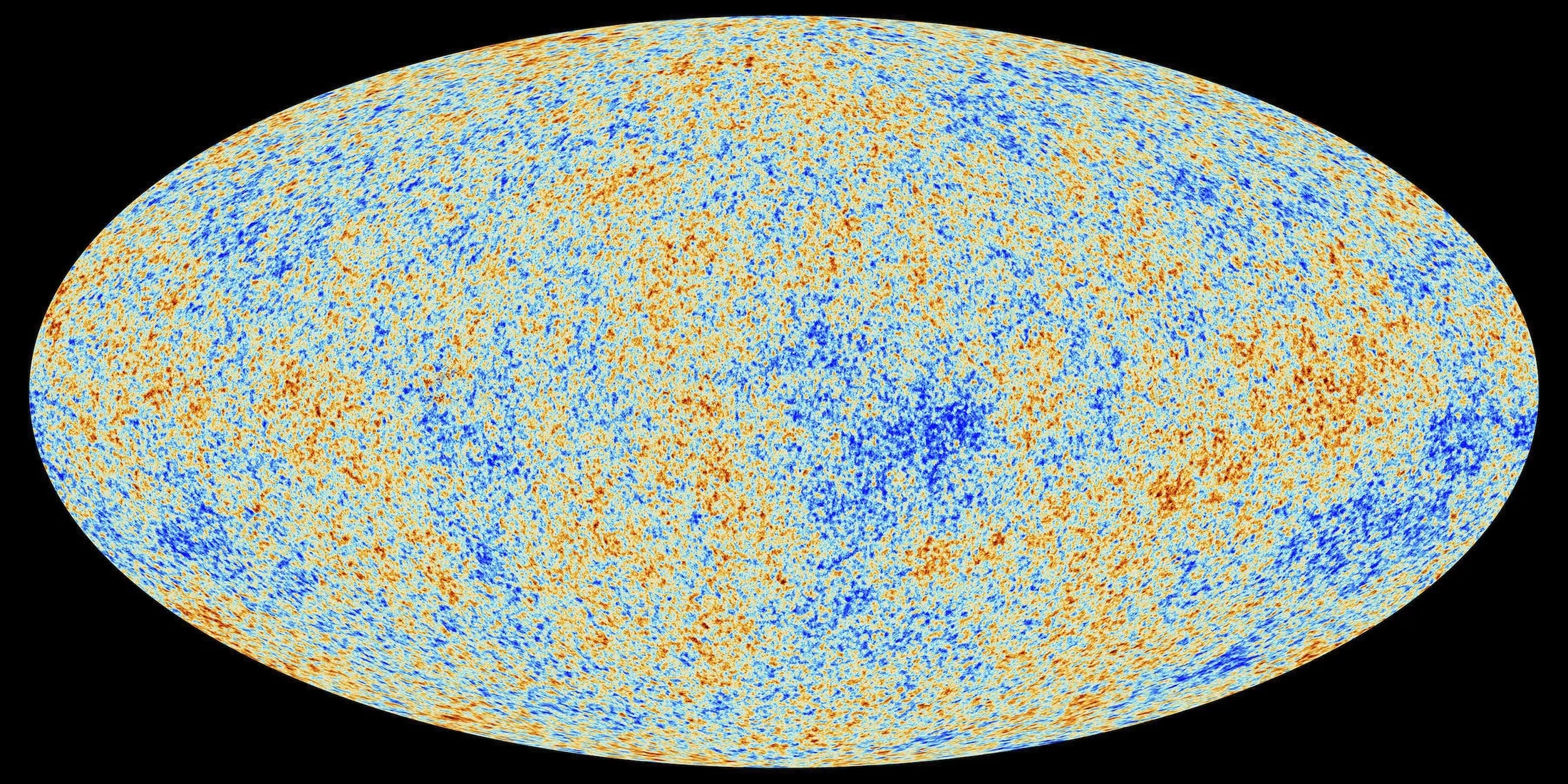
What those ripples mean is the quiet punchline of the whole chapter. The map is smooth to about one part in 100,000 — almost perfectly uniform — yet the tiny patches that are a few millionths of a degree cooler or hotter are not random noise. On the largest scales, the slightly cooler spots mark places that were slightly denser, and over the following billions of years gravity pulled ever more matter into exactly those places. Every galaxy, every cluster, every thread of the cosmic web grew from this faint mottling. The CMB is at once the oldest light we can ever see — a wall of glow 13.8 billion years away — and the baby photograph of every structure that was still to come.
The CMB is the edge of the visible Universe: a sky-wide flash from the moment atoms first formed, stretched a thousandfold, chilled to three degrees above absolute zero, and still carrying the seed-pattern of every galaxy that would ever exist.