Our Galaxy's Anatomy
Everything in the last chapter — the four forces, the first atoms, the afterglow of the Big Bang (§1.4) — set the stage. Now structure assembles, and the first great structures to form were galaxies. Our home address among them is the Milky Way: a galaxy is a vast, gravity-bound island of stars, gas, and dust, and ours holds a few hundred billion stars. Seen edge-on it is a startlingly flat pancake about 100,000 light-years across (a light-year is the distance light travels in a year, about 9.5 trillion kilometres) yet only about 1,000 light-years thick — proportionally thinner than a sheet of paper. That bright, flat layer is the thin disk, where gas keeps collapsing into new stars; it sits inside an older, fainter thick disk a few times deeper, whose stars have been jostled out of the plane over billions of years.
At the centre swells the bulge, a dense, football-shaped crowd of the Galaxy's oldest stars, drawn out into an elongated bar about 25,000 light-years long — which is why the Milky Way is classed as a barred spiral. Buried at the very centre is a supermassive black hole, Sagittarius A*, weighing about 4 million Suns; tracking the stars that whip around it won the 2020 Nobel Prize in Physics. Wrapping the whole disk is the halo, a vast, thinly populated sphere of ancient stars on randomly tilted orbits, studded with about 150 globular clusters — tight balls of up to a million of the oldest stars known.
Seen face-on, the disk resolves into a magnificent pinwheel. Spiral arms — bright lanes of gas, dust, and short-lived blue stars — wind outward from the ends of the bar; counting the old stars, two main arms stand out (Scutum–Centaurus and Perseus), though tracing the gas reveals more. Our Sun is not at the centre of any of this. It sits about two-thirds of the way out, roughly 27,000 light-years from the centre, on a minor spur called the Orion Spur — a fact first established in 1918, when Harlow Shapley mapped the globular clusters and found they circle a point far from us, toward the constellation Sagittarius (his Galaxy was right, though several times too big). From that suburban perch the whole Solar System sweeps around the centre at about 230 kilometres per second, taking some 220 million years to finish one lap — a single "galactic year," of which the Sun has lived only about twenty. The diagram below lays all of this out, from two angles at once; click any part, or step through with the arrow keys.
The View from Inside
There is a catch in everything just described: no one has ever seen the Milky Way from outside. We are stuck within the disk, 27,000 light-years from the centre, and cannot travel even a thousandth of the way out to look back. So the face-on pinwheel and edge-on pancake above are not photographs — they are models, painstakingly reconstructed by surveying the positions and motions of stars, gas, and dust in several kinds of light at once (visible, infrared, and radio — see §0.4), and by comparing our Galaxy with the countless others we can see from the outside, the subject of the lessons ahead.
What we see directly, on a dark and moonless night far from city lights, is the Galaxy edge-on from within: a hazy, irregular band of light arching from horizon to horizon. That glow is the merged light of countless stars too faint and far to separate by eye, and the dark rifts running through it are not gaps but clouds of interstellar dust blocking the starlight behind them. The band is brightest and most swollen toward the constellation Sagittarius — because that is the direction of the crowded Galactic centre. The panorama below is exactly this view; hover to magnify the star clouds and dust lanes.
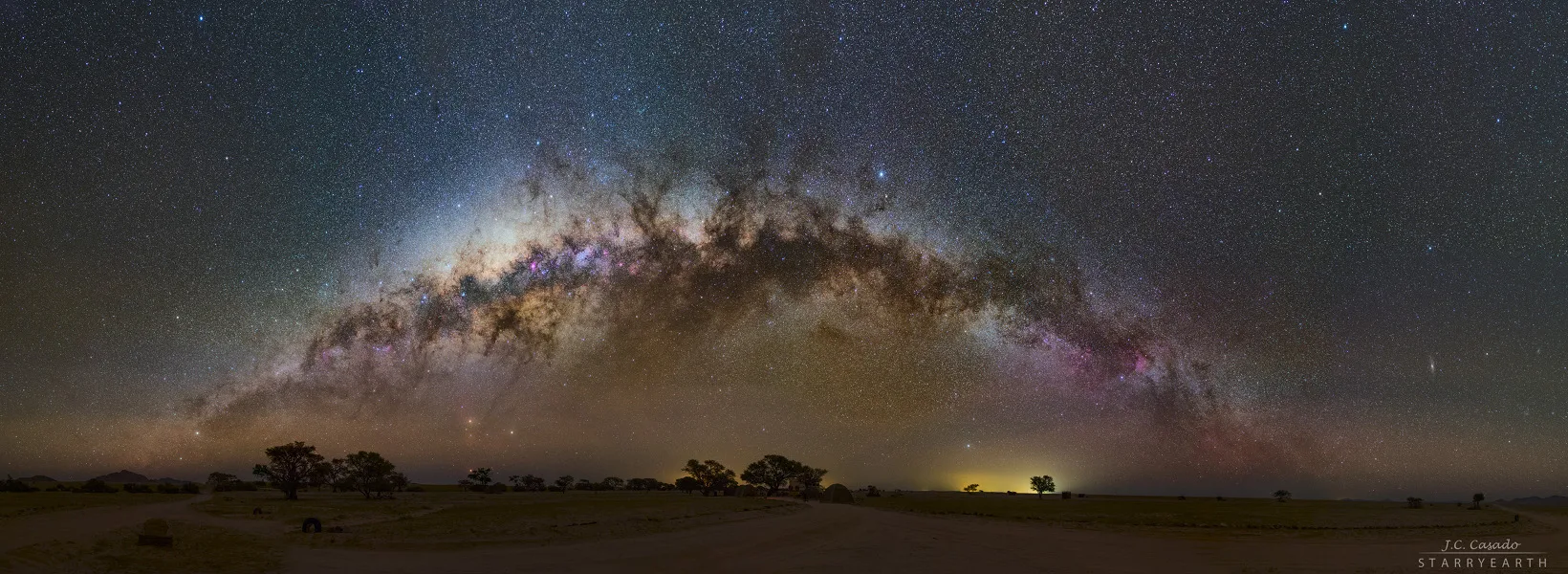
Because Earth circles the Sun, the slice of the disk we face at night shifts through the year. On summer nights the band blazes overhead and thickens toward the centre in Sagittarius; in spring it lies flat along the horizon, leaving the overhead sky clear so that we gaze straight up out of the disk, toward the near-empty space between the galaxies. It is a strange vantage point from which to take stock: a single quiet star, two-thirds of the way out one arm of one barred spiral, reading the shape of its entire galaxy from the light washing over it from inside.
One galaxy, two views — and we live inside the picture. Next we step outside it, to see how our Milky Way compares with the billions of other galaxies that fill the Universe.