The Cosmic Web
By the time the first atoms had formed and the afterglow of the Big Bang set out across space (§1.4), the Universe was filled with a thin, almost featureless gas — hydrogen and helium spread nearly evenly in every direction. But not perfectly evenly. Faint ripples ran through that gas, patches no more than one part in a hundred thousand denser than their surroundings. Those whispers of unevenness were the seeds of everything that followed — the very same ripples printed on the cosmic microwave background, the baby picture of §1.4.
Gravity is patient. In each slightly crowded patch, the extra pull of matter — most of it dark matter, an invisible substance far more plentiful than ordinary matter that betrays itself only through its gravity — drew in still more gas. The crowded spots grew denser while the empty regions drained emptier, and over hundreds of millions of years the gas in the densest knots collapsed under its own weight until it grew hot enough to ignite the first stars and assemble into the first galaxies.
Run that process forward and something unexpected emerges: a cosmic web. The Millennium Simulation — a landmark 2005 computer model built by Volker Springel and the Virgo Consortium — followed a representative chunk of the young universe under nothing but gravity, all the way to the present day. What grew was not an even sprinkle of galaxies but a sponge-like network: bright filaments of galaxies meeting at dense clusters, wrapped around vast, near-empty voids. Drag the time slider in the figure below to run that same growth forward yourself, from a near-uniform haze to the web in full.
This is no simulation's daydream. When astronomers charted the real positions of millions of galaxies — first in the Sloan Digital Sky Survey and the 2dF Galaxy Redshift Survey — they found exactly this architecture: galaxies and clusters strung along interconnected threads and sheets that curl around enormous voids. The largest of these features are staggering. The Sloan Great Wall, a sheet of galaxies mapped in 2003, stretches about 1.4 billion light-years — a single connected structure reaching roughly a thousandth of the way across the entire observable Universe.
The whole web is, in a sense, a magnified fossil of the infant Universe. Cosmologists trace its blueprint back to microscopic quantum fluctuations — tiny, random variations in density — present in the Universe's first split second. During a fleeting early burst of expansion called inflation, those microscopic ripples were stretched to astronomical size, laying down the pattern that gravity has been sharpening into filaments and voids ever since. The faint warm and cool spots on the cosmic microwave background (§1.4) and the cosmic web are the same seeds, seen at two very different ages. And as the first galaxies switched on, their fierce ultraviolet light reached out and tore the electrons back off the surrounding hydrogen — the Epoch of Reionization — flooding the young web with starlight.
How Galaxies Grow
The galaxies that first lit up along the web were not the grand designs of §2.2 — they were small, ragged, gas-rich fragments. Galaxies grow mostly from the bottom up, by hierarchical merging: gravity keeps drawing smaller pieces together into larger ones, the way streams feed rivers that feed a sea. Because the early Universe was far more crowded than today's, these collisions were frequent — and merging has been the main engine of galaxy evolution ever since.
A galaxy collision is anything but tidy. As two galaxies swing past or plough through each other, their gravity wrenches both out of shape, flinging long streamers of stars and gas — tidal tails — out into space and slamming clouds of gas together. Compressed gas collapses into stars, so a single collision can trigger a galaxy-wide burst of star formation: a starburst, igniting thousands of brilliant young star clusters at once. But the lasting outcome turns on one thing above all — the relative sizes of the two galaxies. Scrub through the encounter in the figure below, and toggle between a merger of equals and a lopsided one.
When two comparable spirals collide — a major merger — the wreck is total: the delicate disks and spiral arms are destroyed, the stars flung onto random orbits, and what settles out is a smooth, featureless elliptical. This is how many of the ellipticals on Hubble's tuning fork (§2.2) were built — not by slowly ageing along the fork, but by sudden, violent assembly. A minor merger is gentler: a large spiral swallows a much smaller dwarf galaxy, thickening and ruffling its disk a little but leaving its overall shape intact. That is how our own Milky Way has grown — by quietly cannibalizing dwarf after dwarf.
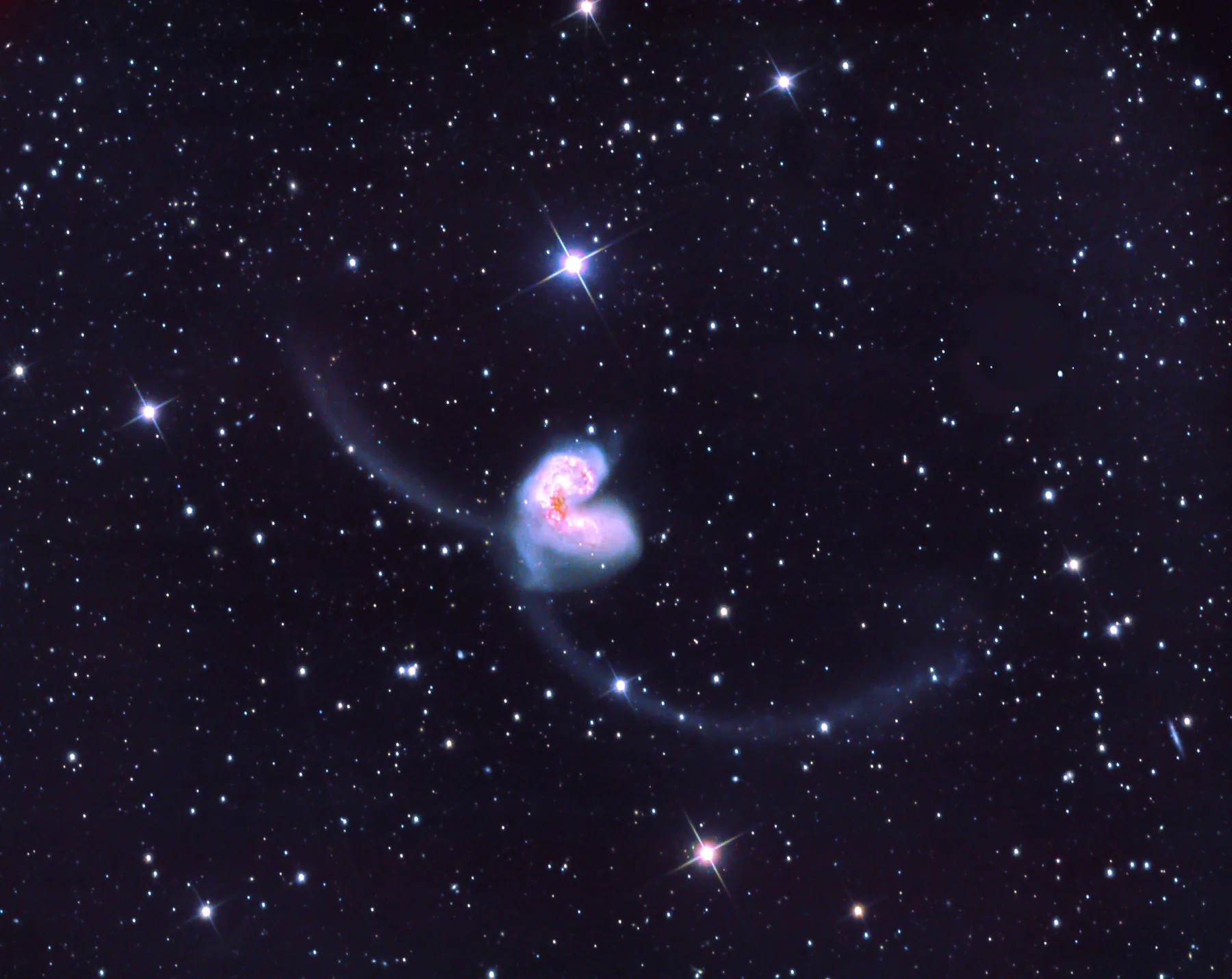
The sky is full of these encounters frozen at every stage. The Whirlpool (M51) trails a luminous arm drawn out by a small passing companion; the giant elliptical Centaurus A (§2.2) wears a dark band of dust, the indigestible remains of a spiral it once swallowed. Closer to home, the Milky Way is pulling apart the Sagittarius dwarf galaxy at this very moment. But the most photogenic merger of all is the Antennae — two spirals caught in the thick of a major collision, ablaze with starburst clusters. The picture below is the real thing, from the Hubble Space Telescope; switch on zoom to explore it up close.
Our own Galaxy's story is not finished either. The Andromeda Galaxy, the nearest large spiral to ours, is drifting toward us, and for years astronomers expected the two to fuse into a single giant elliptical a few billion years from now. More careful measurements have since muddied that forecast — once the gentle tugs of our smaller galactic neighbours are folded in, a collision within the next ten billion years now looks closer to a coin-flip than a certainty. The one sure thing is that the building never stopped.
From the faint seeds of the Big Bang to a web of galaxies, endlessly merging and reshaping — that is how the Universe assembled its structure. Next we listen to how these galaxies move, and find that almost every one of them is racing away from us: the first clue that the whole Universe is expanding.