The Hubble Tuning Fork
The Milky Way (§2.1) is one galaxy among perhaps two trillion, and they are not all alike. Almost all of them, though, fall onto a single diagram Edwin Hubble drew in 1936 — the tuning fork. Its handle holds the ellipticals (E): smooth, featureless balls of mostly old, reddish stars, with little cold gas left to forge new ones. They are labelled E0 (round) through E7 (cigar-shaped) by how squashed they merely look on the sky — a number about appearance, not true 3-D shape.
Where the fork splits sit the lenticulars (S0): they have the central bulge and flat disk of a spiral, but smooth and gas-poor like an elliptical — "transitional" in looks, not a stage a galaxy passes through. The two prongs are the spirals. Ordinary spirals run Sa to Sc — from a fat central bulge with tightly wound arms, toward a small bulge with loose, open arms and far more gas and young blue stars. The lower prong, SBa–SBc, are barred spirals: the same, but with a straight bar of stars across the core that the arms trail from. Bars are no curiosity — roughly two in three disk galaxies have one, our own Milky Way included.
One caution about the fork: astronomers call the ellipticals "early-type" and the spirals "late-type," but those are just names for where a galaxy sits on the diagram — borrowed long ago from how stars were sorted. They say nothing about age, and no galaxy slides along the fork as it grows. The tidy shapes are instead the calm result of some eleven billion years of upheaval. The early universe was full of small, gas-rich, clumpy fragments crashing together; mergers piled some of them into ellipticals, while disks slowly cooled and settled into spirals. (Modern telescopes like JWST do find a few orderly disks surprisingly early, so the young universe was not pure chaos — but clumpy, colliding galaxies grow steadily more common the further back we look.) Drag the time slider below and watch the whole fork dissolve into its turbulent past.
Active Galaxies
Most galaxies are "normal": their light is simply the sum of their stars. But a small fraction pour out more energy than all their stars combined, from a region no bigger than our Solar System — an active galactic nucleus, or AGN. The engine is a supermassive black hole, millions to billions of times the Sun's mass, devouring gas through a blazing-hot accretion disk spiralling in. Gas whirling close to the hole moves fast and dense, smearing its light into broad emission lines; gas drifting farther out moves slowly, giving sharp narrow lines. A thick, doughnut-shaped torus of dust rings the disk, and many AGN fire twin jets of particles out along their poles at nearly the speed of light.
Here is the twist that ties it together. The zoo of names — Seyfert, quasar, blazar — is largely one kind of object seen from different angles. Peer over the rim of the torus at the naked disk and you catch both broad and narrow lines: a Type 1 active galaxy (a Seyfert if modest, a quasar if blindingly luminous). View it edge-on and the dusty torus hides the disk and the broad-line gas, leaving only the narrow lines: a Type 2. Look straight down a jet and its beamed glare drowns everything else: a blazar. The 3-D model below lets you fly around a single AGN and watch its type flip as your viewing angle alone changes.
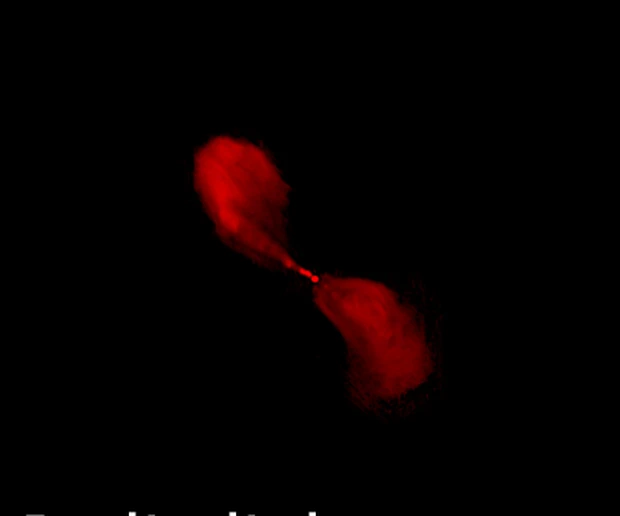
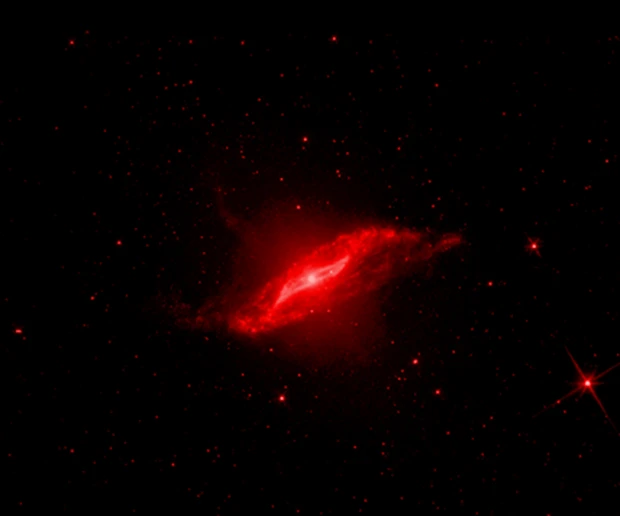
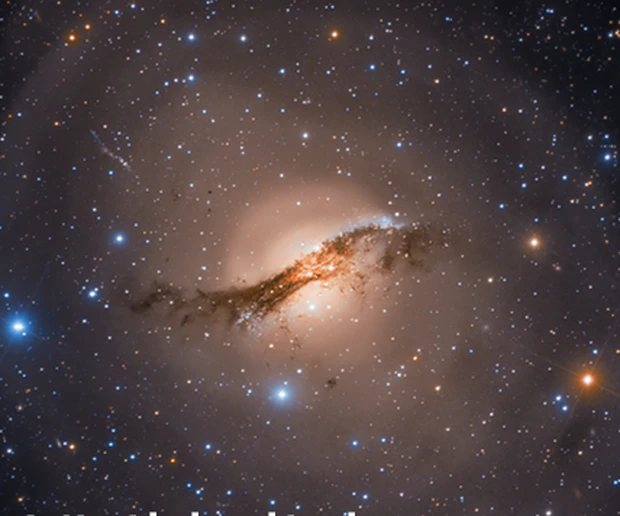
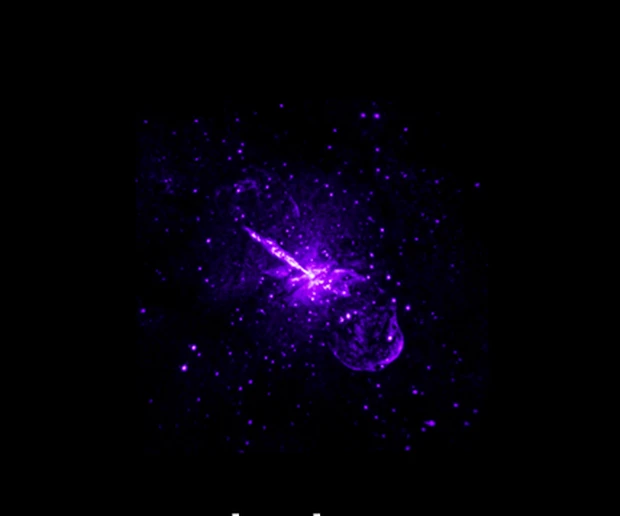
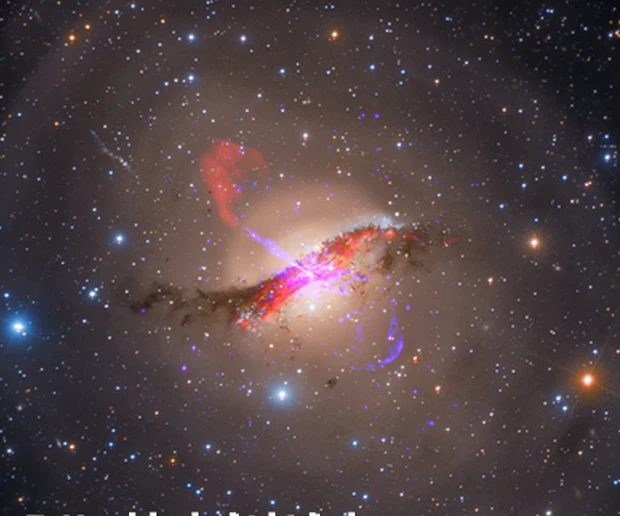
Two honest caveats. Only about one active galaxy in ten actually launches the powerful jets drawn above — most are "radio-quiet," with weak jets or none — so the jet belongs to a minority of these objects. And the viewing-angle picture, powerful as it is, is not the whole truth: real AGN also differ in how fast they feed, the dusty torus is clumpy rather than a smooth doughnut, and a few stubborn galaxies refuse to fit at all. Treat orientation as the leading explanation, not the last word. To see how violent these objects really are, it helps to look at one across many kinds of light at once (§0.4) — as in the portrait of Centaurus A below.
From a single fork of shapes to a single black-hole engine in many disguises — the galaxies are sorted. Next we ask how they were built and how they grow, and then how their motions revealed that the whole Universe is expanding.